
HOME | ARTICLES | BOOK REVIEWS | LIVE DISCUSSION | ABOUT US | ARCHIVES

Feeling Good
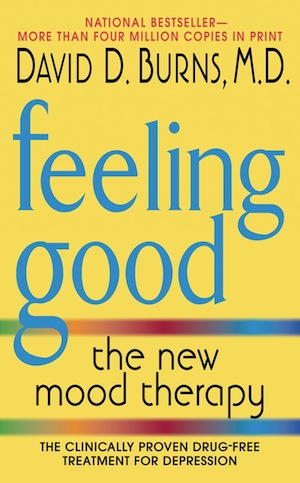 The New Mood Therapy (Revised and Updated)
 Many of our members suffer from depression from years of being in an invalidating home environment. Feeling Good is the book most frequently "prescribed" by psychologists for patients undergoing Cognitive Behavioral Therapy (CBT). Clinical studies have shown patient improvement by just reading the book - a treatment known as bibliotherapy. Four (4) million copies have been sold in the United States.
Surveys indicate that American mental health professionals rate Feeling Good as the #1 book on depression, out of a list of 1,000 self-help books.
In Feeling Good, David D. Burns, M.D., outlines proven Cognitive Behavioral Therapy techniques that will help you emerge from depression and develop a more positive outlook on life. CBT is a method developed by Aaron T. Beck in the 1960s - this book popularized it and brought it to the forefront for treating depression. CBT is effective for:
Dealing with guilt
Handling hostility and criticism
Overcoming addiction to love and approval
Building self–esteem.
In one well know part of the book, Burns discusses 10 'Cognitive Distortions'. Here, he lays out a plan for recognizing faulty thinking, how these thoughts affect our moods, and how to correct these distortions.
~ All-or-Nothing Thinking
~ Overgeneralization
~ Mental Filter
~ Disqualifying the Positive
~ Jumping to Conclusions
~ Magnification and Minimization
~ Emotional Reasoning
~ Should Statements
~ Labeling and Mislabeling
~ Personalization.
Relatively few self-help books have been empirically tested in clinical studies. Feeling Good has been studied and when used alone (without live therapy) has has fared very well, with an average effect size roughly equivalent to the average effect size obtained in live psychotherapy studies. Bibliotherapy broke ground for the computer-based treatments have been developed for those interested in self-administered treatments (see Journal of Clinical Psychology, Volume 59 Issue 3, Pages 275 - 288)
David D. Burns, M.D. graduated magna cum laude from Amherst College, received his M.D. from Stanford University School of Medicine and completed his psychiatry residency at the University of Pennsylvania School of Medicine. He has served as Acting Chief of Psychiatry at the Presbyterian / University of Pennsylvania Medical Center (1988) and Visiting Scholar at the Harvard Medical School (1998) and is certified by the National Board of Psychiatry and Neurology.
Dr. Burns is currently Adjunct Clinical Professor Emeritus of Psychiatry and Behavioral Sciences at the Stanford University School of Medicine, where he is involved in research and teaching. He has received the A. E. Bennett Award for his research on brain chemistry, the Distinguished Contribution to Psychology through the Media Award, and the Outstanding Contributions Award from the National Association of Cognitive-Behavioral Therapists. He has been named Teacher of the Year three times from the class of graduating residents at Stanford University School of Medicine.
In addition to his academic research, Dr. Burns has written .
# Paperback: 736 pages
# Publisher: Harper; 1980, Reprint edition (2008)
# Language: English
# ISBN-10: 0380810336
# ISBN-13: 978-0380810338

BPDFamily.com Book Endorsements* Other Staff Book Reviews
|
Feeling Good: The New Mood Therapy I Don't Have To Make Everything All Better The Narcissistic / Borderline Couple The Essential Family Guide Surviver to Thriver Manual |
Member Book Reviews Updated: 06/03/14
HOME | ARTICLES | BOOK REVIEWS | LIVE DISCUSSION | ABOUT US