

Logo: Facing the Facts
BPD Book ReviewsPeer support for partners and family of borderline personality loved onesAbout Facing the FactsArticlesBPD Family ResourcesHelens World of Resources on Borderline personality Disorder
 

The Essential Family Guide to Borderline Personality Disorder
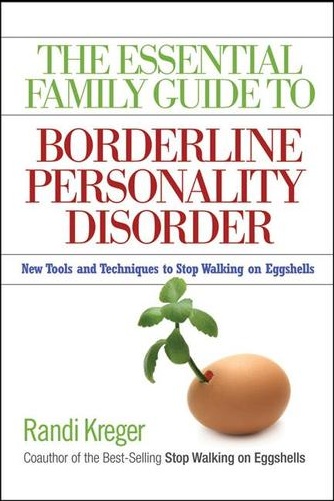
New Tools and Techniques to Stop Walking on Eggshells

by Randi Kreger

Summary: This book is for family members of a person with borderline personality disorder (BPD). If you are only going to have one book, or if you are purchasing your first book, this would be our recommendation. Ms Kreger discusses five tools to make home life more manageable for family members and more constructive for the person affected with BPD.

Book Description

This book is for family members of a person with borderline personality disorder (BPD). If you are only going to have one book, or if you are purchasing your first book, this would be our recommendation.


This is a follow on to the popular "self-help book" for families - Stop Walking on Eggshells. While Stop Walking on Eggshells is often recommended by therapists as The Essential Family Guide is not as well known, this is a later addition and a better book. In the 10 year period following the first book, both the author and he state-of-the-art advanced.

Ms Kreger spends the first half of the book discussing the disorder - the origin and cause of the disorder, symptoms and diagnosis of BPD, including why BPD is so misdiagnosed; how symptoms can differ by age and gender; and how addiction and other disorders complicate BPD, and she covers all of the common treatments, etc..

The second half of the book focuses on five tools for family members to use to make home life more manageable for the family and more supportive of the person affected by BPD.

Take Good Care of Yourself (Tool 1) In Chapter 7, Kreger discusses important concepts such as “don't take things personally”, “get in touch with your true feelings”, “accept what is, not what you hope to be”, and“attend to your own wellbeing and otherwise take your self". She wisely points out that before attempting anything with another person, we need to look at ourselves.

Uncover What Keeps You Feeling Stuck (Tool 2) In Chapter 8, Kreger discusses things about us that make it difficult for us to navigate these relationships and how to deal with them - things such as fear, obligation, guilt, shame, unhealthy bonding (low self-esteem, depression, codependency, etc.). She explains, in short, though we often get caught up in these relationships and are part of the dysfunction.

Communicate to Be Heard (Tool 3) In Chapter 9, Kreger explores the very important aspects of how to effectively communicate to very sensitive person. People with Borderline Personality Disorder often interpret common communications and actions as slights and defamation. Kreger uotlines communication tools that would benefit any relationship - but are absolutely essential in a relationship with a person with borderline personality disorder.

Set Limits with Love (Tool 4) In Chapter 10, Kreger explores the very important aspects of how to effectively set "limits" in a relationship with to very person.that has bad boundaries People with Borderline Personality Disorder are well known for having unhealthy boundaries and expectations of others. In this chapter Kreger outlines tools that would benefit any relationship - but are absolutely essential in a BPD relationship.

Reinforce the Right Behavior (Tool 5) In Chapter 11, Kreger Explains is reinforcing the right behavior, and equally important, not rewarding bad behavior (which we often do). She also explains “extinction burst”s are and how to respond to them.

This book also answers common questions that family members often have in clear simple language such as the symptoms and treatment of BPD, why BPD is so often misdiagnosed; how symptoms can differ by age and gender; and how addiction and other disorders complicate BPD.

Review

Many books have been written about BPD since 1996 and the publication of Stop Walking on Eggshells and frankly there are better books out there for explaining the disorder. Where Kreger excels is in explaining the basics of how to deal with a BPD loved one. This book is an excellent first read. The reader is cautioned, however, that the skills and the self analysis are far from simple. This is only the beginning and a support group is really important.

In another review of the book, Kristalyn Salters-Pedneault, PhD noted a few drawbacks of the book. First, the structure of some of the chapters was a bit confusing; Ms. Kreger often interjects with side notes, and this can detract from the flow of the chapter. Also, I found that Ms. Kreger occasionally uses language that is a bit too conclusive given the state of the research literature; there is still much we need to learn about BPD, and it would be helpful if the language she used better reflected the relative infancy of our understanding.

About the Author

To approach this task, Ms. Kreger read broadly on the subject, interviewed many of the preeminent experts in the field (including Drs. Robert Friedel, Blaise Aguirre, Jim Breiling, Perry Hoffman and John Gunderson), and drew from her own experiences as moderator of the Welcome to Oz forum, an online community of BPD family members. She has done a remarkable job of integrating a very broad and diverse set of information into one complete work.

The task of writing this book was particularly difficult given that BPD, itself, has been studied extensively, but very little research has been done on the impact of BPD on the family (although recently, more researchers have begun to focus on this issue). Unfortunately, this means that Ms. Kreger was not able to draw from an extensive peer-reviewed scientific literature. Hopefully, though, her work will provide the impetus for more systematic study of the issues she addresses.
Something for Every Family Member

Randi Kreger is a professional writer and blogger. She coauthored Stop Walking on Eggshells, on of the first self-help books in this field in 1998 with Paul T. Mason is a program manager of Child/Adolescent Services and a psychotherapist with Psychiatric Services for St. Luke's Hospital in Racine, Wisconsin.


# Paperback: 250 pages
# Publisher: Hazelden (October 15, 2008)
# Language: English
# ISBN-10: 1592853633
# ISBN-13: 978-1592853632


Departments:
Home | Guidelines | Resources | Support Us | Contact Us

Message Board Information:
Board Guidelines | Board Description

Books:
Loving Someone with Borderline Personality Disorder
The High Conflict Couple
The Essential Family Guide to Borderline Personality Disorder
How to Create a More Satisfying Relationship with a Narcissistic Partner
Borderline Personality Disorder Demystified
Feeling Good: The New Mood Therapy
The Journey from Abandonment to Healing
When Your Adolescent Has BPD
I Don't Have To Make Everything All Better
Understanding the Borderline Mother
I am Not Sick I Don't Need Help!
The Narcissistic / Borderline Couple

Updated: 05/16/12